Inside the Big Data Pavilion
The scene feels dense in that very specific way only large technology trade fairs manage to achieve, where the air hums with conversation, screens glow from every angle, and suits move in slow, purposeful currents between counters and demos. The image captures a wide interior of a modern exhibition hall, all steel beams and suspended lighting rigs overhead, with a strong sense of scale created by the high ceiling and the layered truss system holding rows of spotlights. At the center, an IBM stand dominates the visual field, its tall vertical wall wrapped in a close-up image of server racks, cables aligned like an abstract pattern, and the bold words “big data & analytics” cutting through the background. The branding is unmistakable but restrained, corporate confidence rather than spectacle, as if the message is meant for people who already know why they’re here.
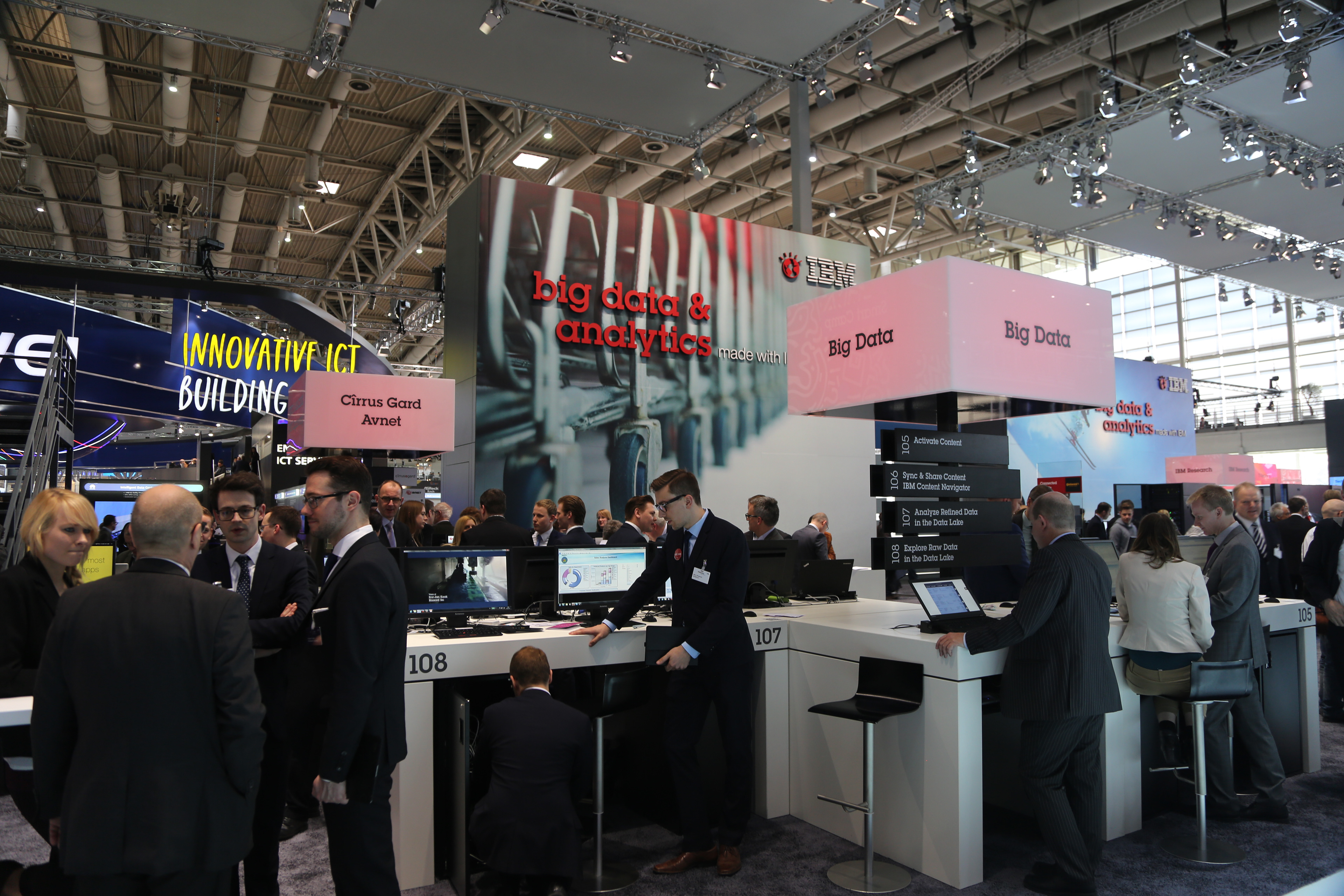
In front of the main structure, white demonstration counters are arranged in a grid-like layout, each marked with black numbers, 105, 107, 108, turning the space into something halfway between a lab and a command center. Flat screens sit atop the counters, displaying dashboards, charts, and interfaces, while attendees cluster around them in small knots. Most are dressed in dark business suits, ties neatly in place, some leaning in with hands on the counter edges, others standing back with crossed arms, listening. A few are mid-conversation, mouths slightly open, hands gesturing subtly, the body language suggesting explanations, negotiations, or those quick, intense exchanges that only happen when time is limited and opportunity feels close. One man crouches beneath a counter, perhaps adjusting cables or hardware, a reminder that even the most abstract ideas in analytics still depend on very physical setups.
To the left, bright signage reading “Innovative ICT Building” glows in yellow and white, contrasting with the cooler, more subdued tones of the IBM area. Nearby, smaller hanging signs identify partners and solution areas, floating above the crowd like waypoints. The lighting is crisp and even, designed to eliminate shadows and keep every product, every face visible, reinforcing the sense of transparency and precision that the analytics theme implies. Despite the crowd, the space doesn’t feel chaotic; it feels orchestrated, each element placed to guide movement and attention, from the towering backdrop to the stools tucked neatly under the counters.
What the image really conveys, beyond branding or technology, is momentum. This is a place where data is not an abstract buzzword but a shared language, where people gather around screens the way others might gather around blueprints or prototypes. You can almost hear the overlapping conversations about integration, scalability, insights pulled from oceans of information. It’s not dramatic, not flashy, but quietly intense, a snapshot of modern industry doing what it does best: bringing people, ideas, and infrastructure into the same physical space, if only for a few days, to figure out what comes next.
Upcoming tech conferences:
- Hannover Messe: Trade Fair for the Manufacturing Industry, 20–24 April 2026, Hannover, Germany
- DesignCon 2026, February 24–26, Santa Clara Convention Center, Santa Clara, California
- NICT at Mobile World Congress 2026, March 2–5, Barcelona, Spain
- Sonar Summit: A Global Conversation About Building Better Software in the AI Era, March 3, 2026
- Cybertech 2026: Proof That the Industry Is Finally Catching Up With Reality
- Chiplet Summit 2026, February 17–19, Santa Clara Convention Center, Santa Clara, California
- MIT Sloan CIO Symposium Innovation Showcase 2026, May 19, 2026, Cambridge, Massachusetts
- Humanoid Robot Forum 2026, June 22–25, Chicago, Illinois
- Supercomputing Asia 2026, January 26–29, Osaka International Convention Center, Osaka, Japan