The Quiet Renaissance of the Local Markets, Part 1
Small local markets are finding their way back into everyday life, not as relics of the past but as an answer to a very current kind of fatigue. Over the last two decades, the global economy has undergone a radical optimization, a relentless push toward a frictionless existence where every need can be met with a silent tap on a glass screen. Big retail is undeniably efficient, and online ordering is remarkably easy, yet many people still find themselves missing the texture of buying things from somewhere that feels specific. This resurgence is not merely a nostalgic retreat into the aesthetics of the “old world.” Instead, it is a sophisticated response to the hollowed-out experience of modern consumerism. We have spent years perfecting the art of the transaction, only to realize that when we remove all the friction from our daily lives, we also remove the opportunities for connection and the sensory richness that makes a day feel lived rather than just managed.
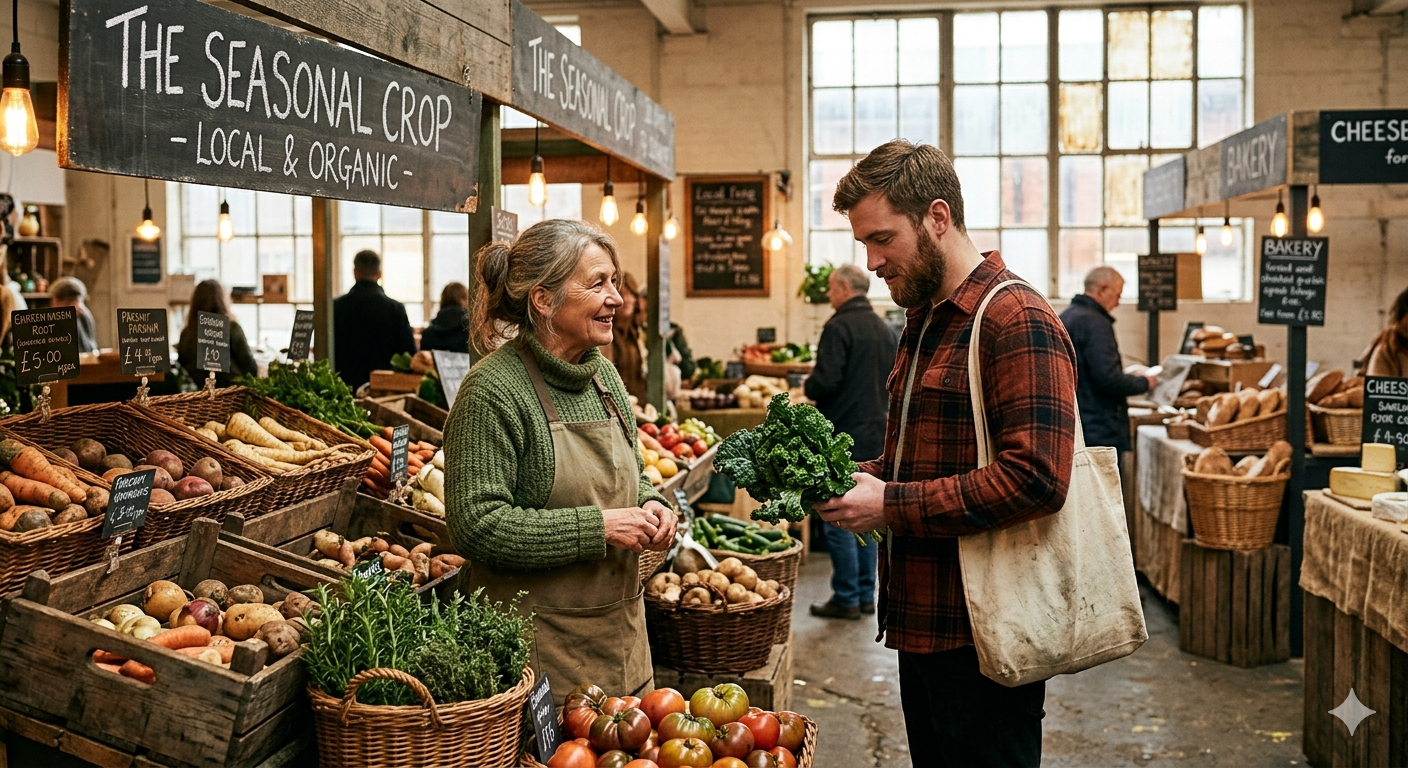
A local market gives more than products; it gives context, familiarity, and a slower rhythm that makes ordinary shopping feel less mechanical. In a supermarket or a digital marketplace, the goal is often to get in and out as quickly as possible, to navigate an environment designed for maximum turnover and minimum interaction. The lighting is clinical, the aisles are standardized, and the human element is frequently relegated to a self-checkout screen or a delivery driver who disappears before the doorbell stops ringing. In contrast, the local market operates on a human scale. It is a space where the architecture of the exchange is built on presence rather than throughput. When you step into these environments, the air feels different. There is a specific acoustic to a bustling market—the murmur of conversation, the tactile sound of paper bags, the physical weight of goods that haven’t been sanitized by layers of plastic and cardboard.
That shift may look minor from a distance, but it fundamentally changes how a neighborhood feels. For many, the neighborhood has become little more than a logistical delivery zone, a collection of coordinates where packages are dropped and cars are parked. The local market reclaims that space, turning a street corner or a small plaza into a social anchor. It provides a “third space,” a concept sociologists use to describe environments outside of home and work where people can engage in the informal public life that sustains a community. When you frequent a local market, you begin to recognize the faces behind the stalls and the regular customers beside you. This recognition is the foundation of social trust. It creates a web of weak ties—those casual acquaintances that, while not deep friendships, provide a sense of security and belonging that a digital interface can never replicate.
We are currently living through a period of “efficiency exhaustion.” We have reached the point of diminishing returns where the time saved by a ten-minute delivery window is immediately lost to the stress of a hyper-connected, always-on lifestyle. The local market offers a necessary counterweight to this acceleration. It invites us to participate in a slower rhythm, one that acknowledges the seasons rather than ignoring them. In a globalized supply chain, everything is available all the time, which sounds like a luxury but often results in a certain blandness. You lose the anticipation of the first spring greens or the deep colors of autumn harvest. At a local market, the inventory is a calendar. You notice the seasons through the produce, the weather through the open storefronts, and the passage of time through the changing light. This alignment with the natural world provides a grounding effect that is deeply restorative in an age of digital abstraction.
Furthermore, the local market allows us to ask questions we would never think to ask a search bar. An algorithm can tell you the price of an item, its nutritional content, and its estimated delivery time, but it cannot tell you about the soil where a specific tomato was grown or how the weather last week affected the flavor of a particular cheese. The market is a place of specialized knowledge and oral tradition. It is where you learn how to prepare a cut of meat you’ve never tried or which variety of apple is best for a specific recipe. This exchange of information is not just functional; it is an act of storytelling. It imbues the objects we bring into our homes with a history and a human origin. When we know the “who” and the “how” behind our belongings, our relationship with them changes. They are no longer disposable commodities; they are the results of someone’s craft and effort.
This return to the specific is also a quiet rebellion against the homogenization of the modern world. Everywhere you go, the “big box” stores and corporate chains look identical. They offer a predictable comfort, but they strip away the unique character of a place. A local market, by its very nature, is unrepeatable. It is shaped by the specific people who run it, the specific history of the building it occupies, and the specific needs of the local population. It is a manifestation of local culture. When we choose to shop in these spaces, we are voting for diversity over uniformity. We are choosing to support a landscape that has “teeth”—something with edges and personality—rather than a smooth, polished corporate facade that looks the same in London as it does in Los Angeles.
The economic implications of this shift are equally significant. When we spend money at a large-scale international retailer, a significant portion of that capital leaves the community immediately. When we spend money at a local market, that capital circulates within the neighborhood. It supports the livelihoods of neighbors, fuels other local businesses, and creates a more resilient local economy. However, the motivation for the modern market-goer is rarely purely economic or even purely ethical. It is emotional. It is a desire for “texture”—the physical and social irregularities that make life interesting. We are discovering that a life without friction is a life without traction. We need the bumps, the conversations, and the occasional inconvenience of the physical world to feel like we are actually participating in our own lives.
The rise of the “smart city” and the “Internet of Things” promised us a world of total convenience, but it often delivered a world of total isolation. The more we automate our basic needs, the more we find ourselves craving the very things we tried to automate away: eye contact, a shared laugh over a counter, the smell of fresh bread, and the feeling of being known in a small corner of a big world. The local market isn’t a replacement for the modern world; it is a necessary companion to it. It is a sanctuary where we can step out of the stream of data and back into the stream of humanity.
In the end, the movement back toward local markets is about reclaiming our agency as participants in a community rather than just consumers in a market. It is an acknowledgement that the most efficient path is not always the most rewarding one. By choosing the specific over the generic, the slow over the fast, and the human over the mechanical, we are slowly rebuilding the social fabric of our neighborhoods. That shift may look minor from a distance, but it changes the very soul of a city. It reminds us that while we can buy almost anything with a click, the things that truly sustain us—connection, context, and a sense of place—must be found in person, one step and one conversation at a time.