Inside the Cobot Boom: What a Yaskawa Trade Show Floor Reveals About Industrial Automation
Walk any major manufacturing or automation trade show floor in 2026 and the pattern repeats itself: rows of white-and-blue articulated arms, each one smaller and friendlier-looking than the massive yellow and orange industrial robots that defined factory floors for the past four decades. This is the collaborative robot, or “cobot,” and its proliferation across exhibition halls is one of the more telling signals about where manufacturing automation is actually heading.
The Scene on the Floor
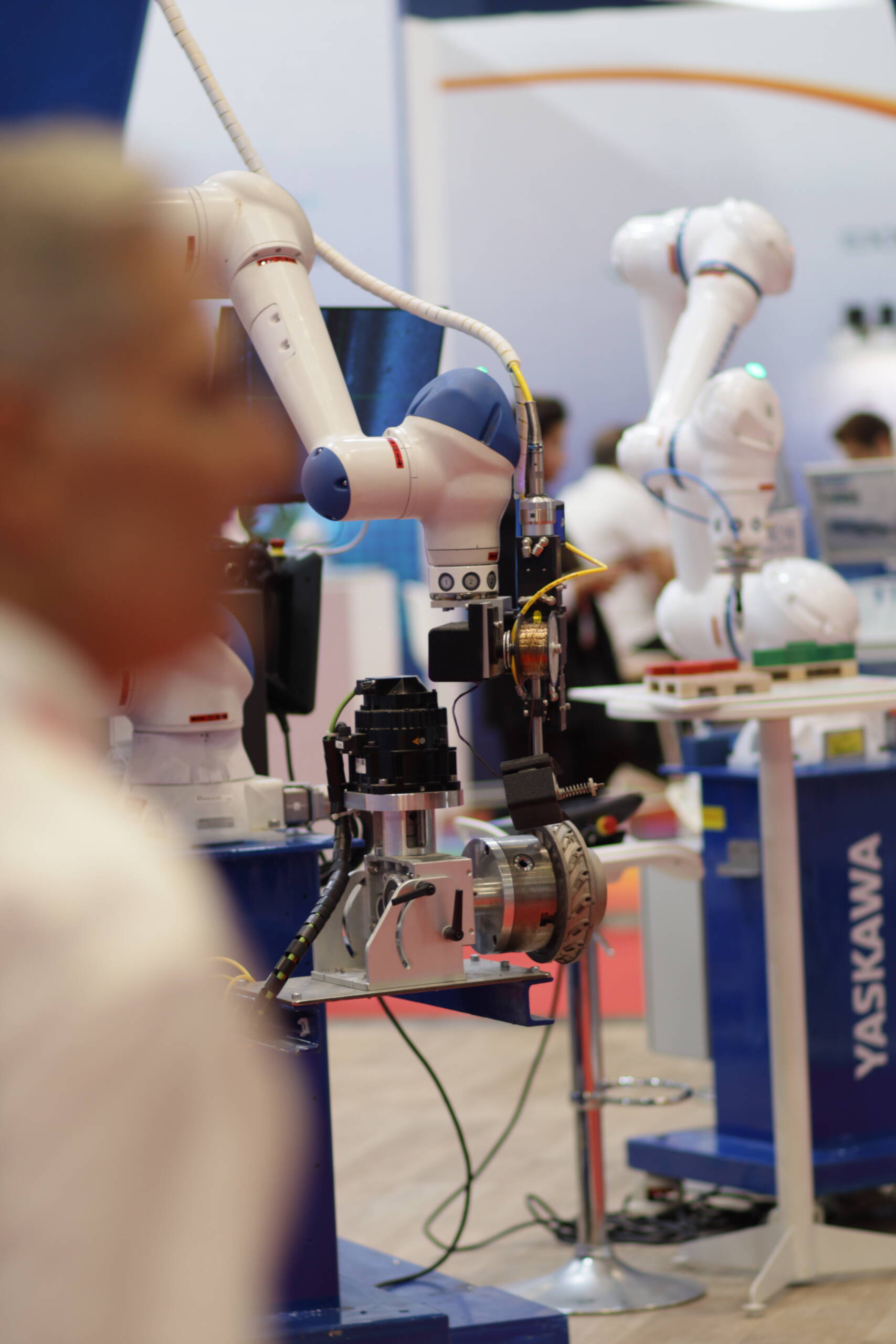
The booth captured here is a Yaskawa installation, one of the giants of industrial robotics alongside Fanuc, ABB, and KUKA. What stands out immediately is the density of arms on display within a small footprint — at least three visible units in a single frame, each mounted on its own pedestal, each doing something slightly different. One arm in the foreground carries a substantial end-effector assembly: a rotary spindle housing, what appears to be a tool-change interface with numbered ports, a copper-wound component that could be a slip ring or transformer, and a tangle of pneumatic and electrical lines feeding into the wrist joint. This isn’t a demo unit doing a simple pick-and-place loop for show. This is closer to a real production tooling head — likely a machining, dispensing, or precision assembly application.
In the background, two more arms with the same rounded, ergonomic joint housings sit on lightweight tables surrounded by small demonstration parts — miniature building blocks, colored components, the kind of stagecraft trade shows use to make abstract industrial capability feel tangible to a non-technical visitor walking the aisle. A green status light glows on the joint of one arm, the universal signal in cobot design language for “safe to approach.”
Why Cobots Look the Way They Do
The rounded, bulbous joint housings visible throughout this booth aren’t just aesthetic choices. They reflect a design philosophy that emerged specifically to distinguish collaborative robots from their traditional industrial predecessors. Classic industrial arms were built for speed and payload inside caged work-cells, with sharp angular housings, exposed pinch points, and zero expectation that a human would ever be within reach during operation. Cobots inverted that assumption. The rounded joints reduce injury risk on contact, the integrated force-torque sensing allows the arm to stop or reverse when it encounters unexpected resistance, and the compact footprint lets the robot share floor space with human workers rather than requiring a dedicated fenced cell.
This matters commercially as much as it matters safety-wise. Fencing, safety scanners, and dedicated cell infrastructure are a huge fraction of the total cost of deploying a traditional industrial robot. A cobot that can work in open space next to a person collapses much of that infrastructure cost, which is precisely why small and mid-sized manufacturers — the ones who could never justify a six-figure caged robotic cell — have become the fastest-growing segment of robotic arm adoption over the past several years.
The End-Effector Is Where the Real Engineering Lives
It’s worth dwelling on the tooling visible at the wrist of the primary arm in this photo, because this is where the unglamorous but commercially critical engineering actually happens. The robot arm itself — the six-axis motion platform — has become something close to a commodity. Yaskawa, Fanuc, ABB, KUKA, UR, and a growing list of Chinese manufacturers including Estun and JAKA all sell broadly comparable arms at broadly comparable price points. The differentiation, and the margin, has moved downstream to the end-effector and the application engineering wrapped around it.
What we can see here — a rotary tool head, a quick-change coupling, pneumatic lines, what looks like a fiber-optic or high-speed data connection running alongside conventional cabling — suggests an application involving either precision machining, a multi-tool changeover process, or metrology-integrated assembly. The small numbered buttons on the housing (a “1, 2, 3” selector visible near the top of the tool assembly) point toward a manual jog or tool-select interface, useful for demo purposes on a show floor where an operator needs to cycle through functions quickly for passing visitors.
This is the part of the robotics industry that doesn’t show up in stock coverage of the big automation OEMs but that quietly generates enormous value: the systems integrators, end-effector specialists, and tooling houses that turn a general-purpose arm into a solution for a specific customer’s specific part.
The Competitive Landscape Behind the Booth
Yaskawa occupies an interesting position in this market. It’s simultaneously one of the largest traditional industrial robot manufacturers in the world — a company whose Motoman line has been a mainstay of automotive welding and material handling for decades — and a company that has had to retrofit its portfolio to compete in the cobot segment against Universal Robots, the Danish company widely credited with creating the collaborative robot category, and against a wave of lower-cost Chinese entrants that have been aggressively taking share in price-sensitive segments over the past two to three years.
The strategic tension for a company like Yaskawa is that its core industrial customer base — automotive OEMs, heavy manufacturing — doesn’t necessarily need cobots. They need speed, payload, and duty cycle, and they already have the capital and floor space for caged cells. The growth market for cobots is elsewhere: electronics assembly, food and beverage packaging, pharmaceutical fill-finish, and the long tail of small manufacturers who were never robotics customers at all. Winning that market requires a different sales motion, different price points, and often a different distribution channel than the one built over decades for heavy industrial customers.
Trade Shows as a Leading Indicator
There’s a reason booths like this one are worth paying attention to beyond their surface appeal. Trade show floor allocation is a decent proxy for where a company believes its growth is actually coming from. A booth built around a single caged high-payload arm doing a repetitive welding demo signals “we are defending our legacy business.” A booth built around three or four compact arms, tool-change demonstrations, and miniature assembly stagecraft aimed at a walking, non-technical audience signals “we are trying to sell to people who have never bought a robot before.”
The presence of visible tool-change infrastructure and what looks like active machining tooling — rather than just a pick-and-place demo — also suggests Yaskawa, and companies like it, are trying to demonstrate that cobots aren’t just for light assembly anymore. The pitch has shifted from “safe robots for simple tasks” to “capable robots that happen to be safe,” which is a meaningfully different value proposition and one aimed squarely at manufacturers who have so far assumed cobots couldn’t handle real production tolerances.
The Bigger Picture
Industrial automation adoption tends to move in long, slow cycles punctuated by labor cost shocks and supply chain disruptions that suddenly make reshoring and automation investment look urgent rather than optional. The past several years have delivered both in quick succession. Combine that with falling arm prices, maturing AI-based vision and grasping systems that make cobots useful for less structured tasks, and a demographic labor shortage in manufacturing across most developed economies, and the trade show floor captured in this photo starts to look less like a niche industrial curiosity and more like an early snapshot of how a meaningful slice of physical production work gets done for the next decade.
The robots on display aren’t the interesting part, ultimately. The tooling bolted to their wrists, the software cycling through demo routines, and the sales conversations happening just out of frame are where the actual industry is being built.