How Phone Cameras Changed Everyday Memory
The shift from film to the ubiquitous smartphone camera has fundamentally altered the “threshold of significance.” In the era of physical film, every press of the shutter was a financial and finite decision; you had twenty-four or thirty-six chances to capture a reality, which forced a constant, internal negotiation about what was truly “memorable.” Today, that friction has vanished. We have moved from selective memory to total documentation. Because the marginal cost of a digital image is zero, we no longer ask if a moment is worth a photo; we simply take the photo because there is no reason not to. This creates a psychological shift where the act of seeing is increasingly mediated by the act of capturing.
This abundance of imagery has turned the personal archive into a vast, unedited data set. In our pockets, the sacred and the mundane sit side-by-side in a single, chronological stream. A high-resolution photo of a child’s first steps is preceded by a screenshot of a grocery list and followed by a photo of a dry-cleaning receipt. This flattening of experience means that while our “memory” is broader, it is also more diluted. The “blur” you mentioned is the result of a cognitive overload where the sheer volume of images makes it difficult for any single moment to stand out. We are building a visual external hard drive for our lives, but in doing so, we often outsource the actual process of remembering to the device itself—a phenomenon known as “photo-taking impairment,” where the brain offloads the detail to the camera and fails to encode the memory deeply.
Yet, there is a distinct beauty in this new “collectible” texture of life. The smartphone camera has democratized the role of the observer, turning everyone into a flâneur of their own existence. We find ourselves noticing the way light hits a brick wall or the strange phrasing on a shop sign precisely because we have the tool to “save” it. This has made the ordinary world feel more vibrant and full of potential. Even the most fleeting, “useless” moments now carry a sense of permanence. We aren’t just living our lives; we are perpetually archiving them, creating a digital shadow that is more detailed than any journal or photo album of the past. The camera has become a permanent bridge between the lived experience and the remembered one, ensuring that nothing is truly lost, even if it is eventually buried under the weight of ten thousand other frames.
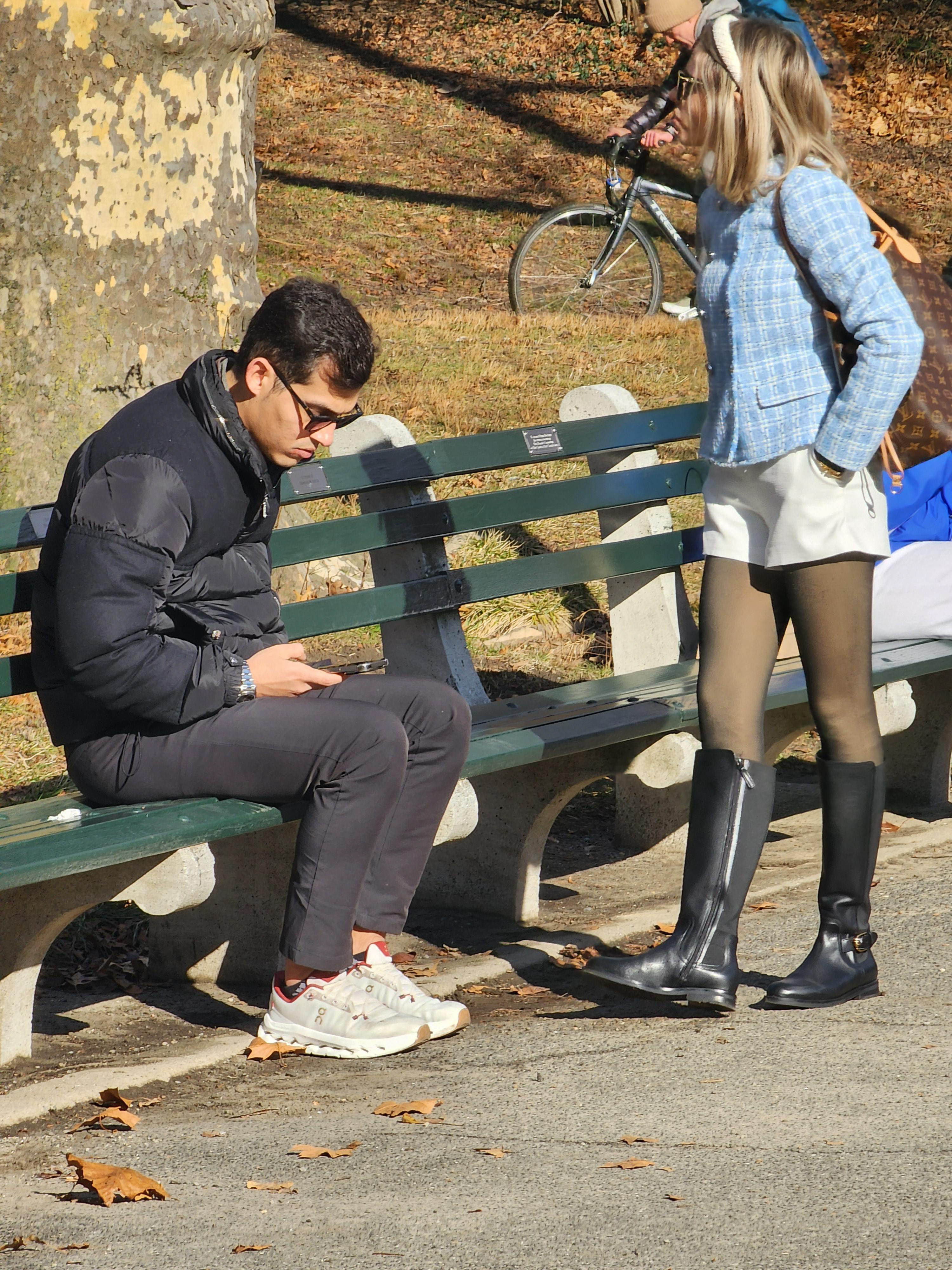
This image serves as a perfect visual thesis for how phone cameras have shifted the threshold of significance and the nature of shared presence. In this single frame, we see the collision of three distinct layers of modern “everyday memory.”
The Documented Self
The woman standing on the right is the embodiment of the “collectible moment.” Her outfit—the structured blue blazer, the white headband, the polished boots—is not merely chosen for the weather, but for its visual impact. In the era of phone cameras, we often dress for the digital archive as much as for the physical environment. She represents the “always-on” nature of modern documentation; even a casual walk in the park is a potential entry in a lifelong visual ledger. This is the aestheticizing of the ordinary, where personal style becomes a deliberate data point in a social narrative.
The Outsourced Memory
On the left, the seated man is deeply recessed into his device, a posture that has become the hallmark of the digital age. He illustrates the fragmentation of attention that occurs when the phone becomes our primary memory bank. While physically present on a sunlit park bench, his cognitive focus is elsewhere—likely engaging with the “abundance and blur” of a digital feed. He is a reminder that while we “remember” more through our devices, we often experience the immediate moment less deeply. He isn’t just looking at a screen; he is interacting with an external hard drive of collective and personal history that competes with the tangible reality right in front of him.
The Accidental Archive
The most fascinating part of the photo is its “broad and dense” quality. Because the cost of taking this image was zero, it captures far more than just the two central figures. We see:
- The background cyclist: An anonymous, fleeting part of a park afternoon, now permanently saved.
- The texture of the environment: The dry leaves, the specific slant of the winter sun, the plaque on the bench.
- The incidental details: The man’s white sneakers, the woman’s bag, the bark of the tree.
In the past, a photographer might have waited for a “cleaner” shot. Today, we embrace the unfiltered abundance. This photo doesn’t just record a person; it records an entire micro-ecosystem of a specific Tuesday morning. It is a “receipt” of a moment that might have once disappeared into the background of a day, but has now been folded into a permanent, searchable archive.