Recent Posts
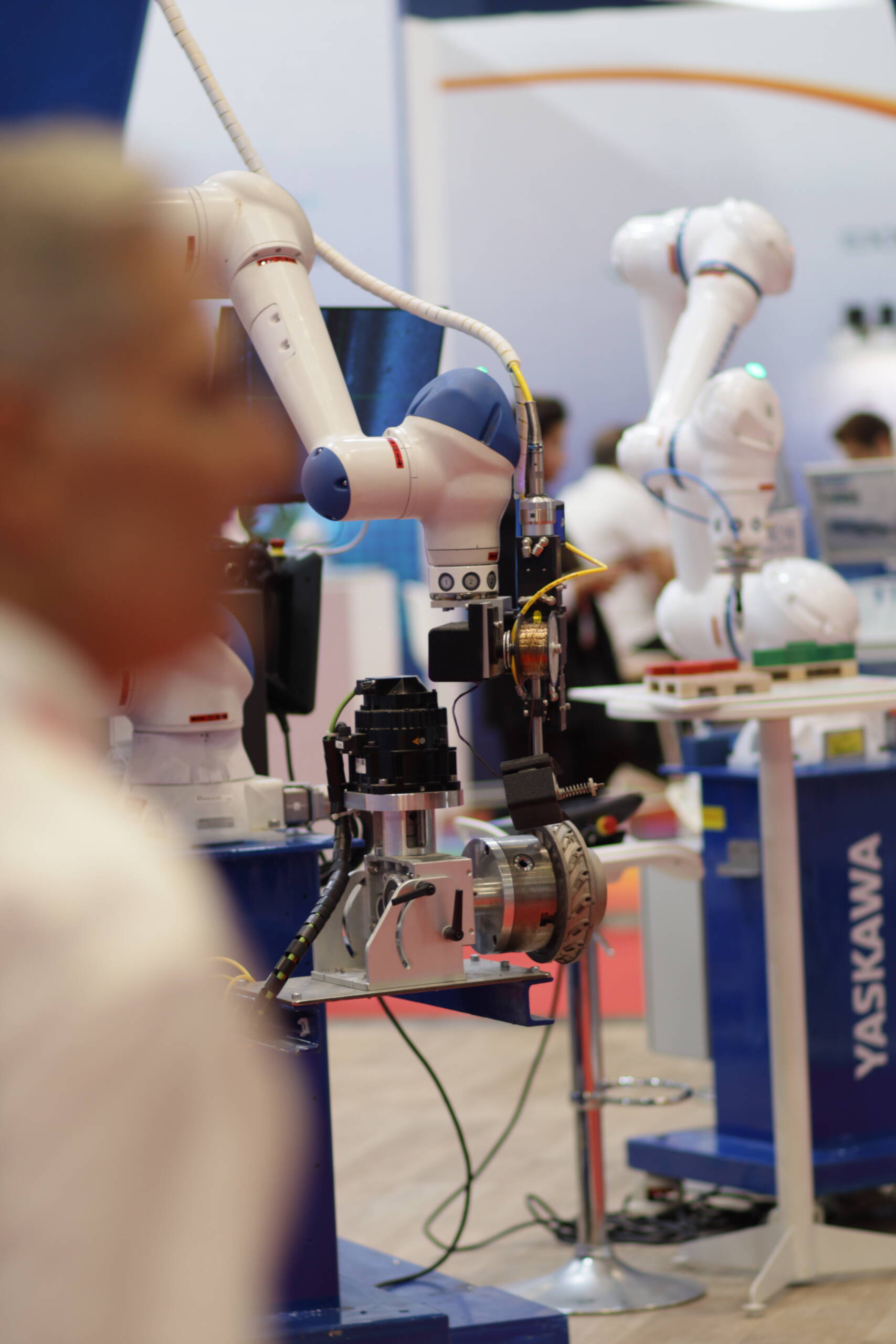
Inside the Cobot Boom: What a Yaskawa Trade Show Floor Reveals About Industrial Automation
Walk any major manufacturing or automation trade show floor in 2026 and the pattern repeats itself: rows of white-and-blue articulated arms, each one smaller and friendlier-looking than the massive yellow and orange industrial robots that defined factory floors for the past four decades. This is the collaborative robot, or “cobot,” and its proliferation across exhibition halls is one of the more telling signals about where manufacturing automation is actually heading.
read more
10Beauty Raises $23.5M to Scale Robotic Manicures Beyond Boston
10Beauty, the Boston-based robotics company behind what it calls the first full-service robotic manicure, has closed a $23.5 million funding round led by Story Ventures. The raise pushes the company’s total funding past $70 million and arrives as it moves from a single-market pilot into a multi-city rollout.
What the Machine Actually Does Unlike nail-polish vending gimmicks or partial-automation concepts that have surfaced in the beauty space before, 10Beauty’s system handles the entire manicure workflow: polish removal, nail shaping, cuticle care, color application, top coat, and drying.
read more
SOX -5.3%: The Case for a Semiconductor Recovery Next Week
The Philadelphia Semiconductor Index closed Friday down 5.29 percent at 13,203.57, its worst session since the spring. The tape read like capitulation. The cause did not. Nothing broke in the semiconductor business on Friday. What broke was the market’s assumption about the price of money, and that is a far more recoverable wound than a demand shock. The case for stabilization next week does not rest on optimism. It rests on the distinction between a rate scare and a fundamental break, and on the fact that every catalyst now pointing down is the kind that exhausts itself.
read more
Wall Street Closes H1 2026 Near Records as the Jobs Print Moves to Thursday and AI-Memory Cracks
The first half of 2026 ends next week with the indexes near record highs and a consensus that is more comfortable than the data underneath it. JPMorgan closed the week by lifting its year-end S&P 500 target to 7,800 from 7,200, framing roughly another five percent of upside as a “Blue Sky” case. The bullishness is not built on earnings revisions or falling rates. It is built on the disappearance of a tail risk: a U.
read more
Marvell (MRVL) Joins the S&P 500 on June 22. The Inclusion Trade Is Already Spent
Marvell Technology becomes a member of the S&P 500 before the opening bell on Monday, June 22. S&P Dow Jones Indices announced the change on June 5; Marvell and Flex enter the benchmark in the quarterly rebalance, replacing Pool Corp and Campbell’s. For an index that already carries Broadcom, Nvidia, and a deepening bench of AI silicon, the addition reads less as a revelation than as a formality the tape priced in weeks ago.
read more
Barilla Opens Good Food Makers 2026 Applications Through July 10
Barilla has opened applications for the eighth edition of Good Food Makers, its co-development program connecting startups and innovators with real industrial environments inside the company’s operations. The application window runs from May 25 to July 10, 2026, targeting startups and innovative companies prepared to test solutions through a structured, execution-focused program.
The program has logged significant traction since its 2019 launch: more than 1,100 startups from over 50 countries have participated, producing 26 pilot projects, with over 20 currently active through solutions developed by program alumni.
read more
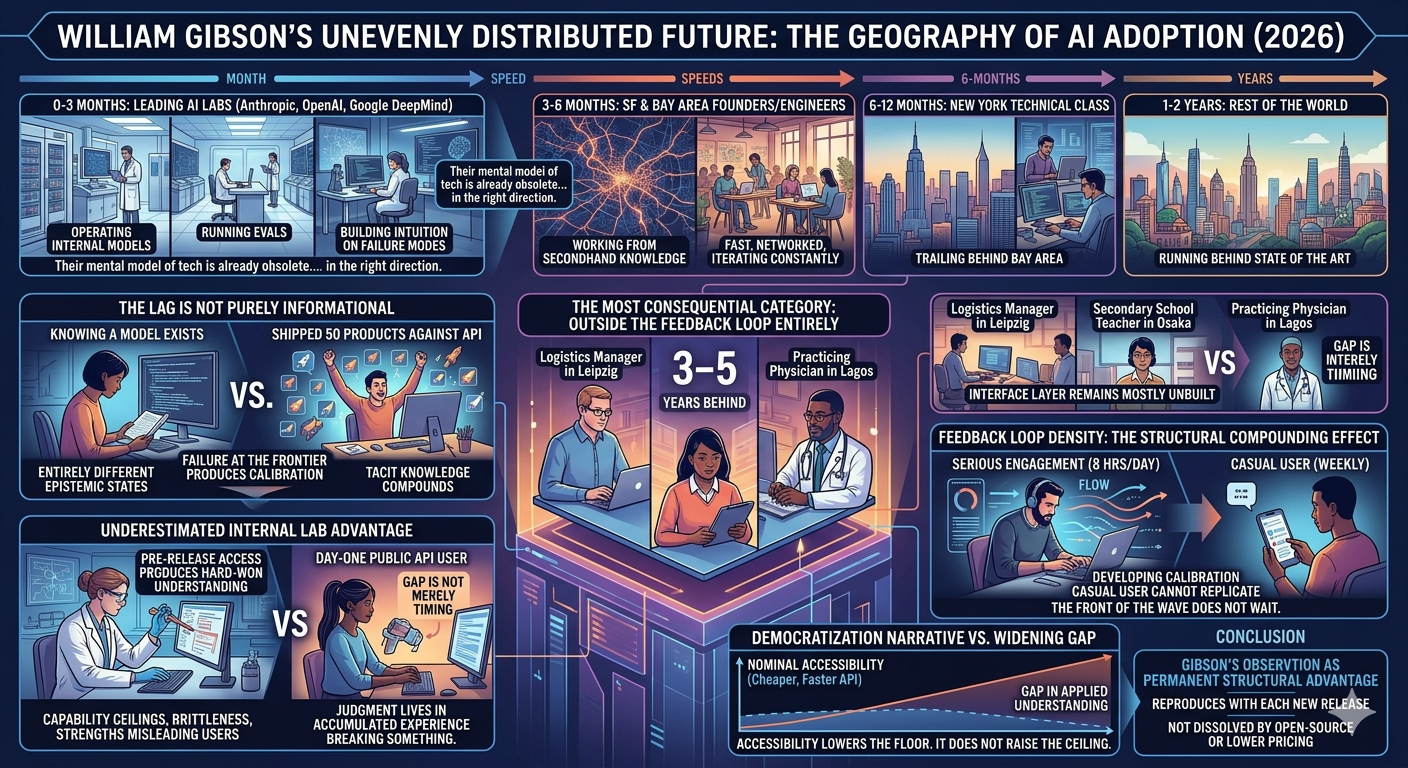
The Future Is Here, Just Not Equally Distributed
William Gibson wrote that the future is already here — it is just not evenly distributed. He was describing the uneven geography of technology adoption, but he could not have anticipated how precisely the line would map onto artificial intelligence in 2026, or how steep the gradient would become.
The distribution follows a rough but observable hierarchy. Researchers and engineers at major AI laboratories — Anthropic, OpenAI, Google DeepMind — are operating with internal models that will not reach the public for another three to four months.
read more
Westin Grand Central, Three Days in May: The 21st Needham Technology, Media & Consumer Conference
The Westin Grand Central is a deliberate choice of venue. Midtown Manhattan, steps from commuter rail, conference rooms arranged for efficient transit between presentations. Needham & Company has been running this event long enough to know that institutional investors do not come to New York in May for the scenery. They come to compress time—to see twelve companies in two days instead of twelve separate roadshows across three months. The 21st Annual Needham Technology, Media & Consumer Conference, running May 12–14, 2026, is an exercise in structured access.
read more
Berkshire Hathaway's Annual Meeting Without Warren Buffett
The Berkshire Hathaway annual meeting in Omaha has functioned for decades as something between a shareholder event and a secular pilgrimage. Warren Buffett and Charlie Munger — and then Buffett alone after Munger’s death in 2023 — provided the gravitational pull. The event drew tens of thousands to Nebraska each May to hear Buffett speak about investing, business, and occasionally the state of the world, in a format that was unreplicable because it depended entirely on a specific person being alive and willing to hold court.
read more
Canelo vs. Benavidez: The Fight Boxing Spent Years Avoiding
Canelo Álvarez and David Benavidez are finally scheduled, and boxing fans have waited long enough to be appropriately skeptical about whether it actually happens. The fight has been discussed, circled, and avoided for the better part of three years. Benavidez has pushed for it publicly. Canelo’s side has found reasons to look elsewhere. The commercial and political mechanics of major boxing matchmaking have a way of producing delay over resolution.
read more